
Have you heard about the new Cricut Explore 3? Wondering what kinds of projects you can create? Today we’re making a custom table runner DIY with Cricut Smart Materials!

INTRODUCING THE CRICUT EXPLORE 3:
I admit I am one of those people who had never tried any “off the mat” or matless cutting projects! This is because I was scared about wasting materials if I screwed up lining up the cuts correctly so they looked seamless, calculating how many mats/rolls I needed per project, etc. I’ve actually had this table runner project in mind for over a year (yes – this runner has been sitting in my craft room that long!) but never got motivated enough to try to figure out how to make it on a regular Explore or Maker. So I only had my Explore 3 out of the box about 10 minutes before I grabbed my runner and made this in about 10 minutes!
{FTC Disclosure: This post is sponsored by JOANN but the project and opinions are mine all mine! Also, this blog post contains affiliate links which means I may make a small commission on any sales at no additional cost to you.}
BEFORE WE START CRAFTING, LET’S TALK ABOUT SMART MATERIALS:
If you are brand new to Cricut or don’t keep up with all the Cricut news, you might be saying ”Beth, what do you mean by ”off the mat” projects?
Well, Cricut now has a new type of material available for crafters called Smart Materials! These Smart Materials allow you to make projects without a cutting mat!
Yes, I said without a cutting mat!
Cricut’s new Smart Materials are just that, smart! You can feed them through your Cricut Joy Machine, Explore 3, or Maker 3, and the software in the machine does the rest of the work for you! This means you can create easy Cricut projects in less time using the concept of matless cutting. Also, it helps you to cut down on the extra cost of buying supplies because the software in your Cricut machine will tell you how much material you need for your project.
Plus, the best part, is that the new Smart Materials come in a wide variety of materials, like the following:
- Smart Iron-On
- Smart Iron-On Glitter
- Smart Iron-On Shimmer
- Smart Iron-On Holographic
- Smart Vinyl Permanent
- Smart Vinyl Removable
- Smart Label Writable Vinyl
- Smart Paper Sticker Cardstock
Besides all the benefits I mentioned above, you can use the matless Smart Materials to make larger projects like the DIY table runner I’m going to show you today! However, it’s still great for smaller projects and you can find other Smart Materials like Cricut Joy Smart Vinyl or Cricut Joy Smart Labels if the Cricut Joy is your favorite machine.
For all of my Cricut newbies out there, Smart Materials is a great place to start if you are wanting to make some easy crafts with your Cricut. So, I highly recommend that you check it out, if you have been on the fence about Cricut in general.
Speaking of being on the fence, make sure you scroll down to the bottom of this post because I answer two common questions about Smart Materials, and share an unboxing video!
SUPPLIES NEEDED:

- Cricut Explore 3
- Cricut Roll Holder for Smart Materials (optional)
- Cricut Smart Iron-on in White (comes in assorted lengths – I used 9’)
- HeatPress (I used the 12”x10” – you can use any size, or you could use an iron)
- HeatPress Mat (I used the 20”x16”)
- Table runner
- Weeding tool
LET’S TALK ABOUT TABLE RUNNERS:
One of the most important supplies in this project, is, of course, the table runner!
Now, technically you have two options when it comes to this DIY project. The first option is to use a homemade table runner and the second option is to use a premade fabric table runner. There are pros and cons to both options, so, to help you make the best decision, I am briefly going to talk about both below.
Homemade Table Runner:
Pros:
- You can pick your own fabric pieces to make a cute table runner that fits your decor style.
- You can design a table runner that is custom to the length of the table you are putting it on. – This could be your dining room table, kitchen table, or even your coffee table.
- You can get creative and make a reversible table runner. – How fun would Smart Materials be on that!
- You can find a video tutorial on YouTube about how to make almost any type of table runner.
Cons:
- You will need sewing tools like a sewing machine, rotary cutter, safety pins, yards of fabric quilting cotton, fusible tape, etc.
- You will need to have some basic sewing skills and be able to sew a seam allowance, raw edges, etc. – Or if you are like me, a straight line (LOL)!
- This project (as a whole) might take you a little bit more time to create since you are starting from scratch.
Premade Fabric Table Runner:
Pros:
- No Sewing!
- It is an inexpensive way to create a custom table runner.
- It makes the project much quicker to create.
Cons:
- You might be limited when it comes to picking the type of table runner fabric that you want.
- You might be limited when it comes to picking the table runner size that you want.
It will probably come as no surprise as to which option I picked!
Sewing table runners is definitely not for me, since I consider myself a member of the beginner sewers club. Due to that, I decided to not make my own table runner but to use one the one I had on hand instead.
If you decide to go the same route, note that not all table runners are alike, and they can be made from different materials, which can affect the final look of your project. So, to save you the headache of wondering which table runner to buy, I highly recommend getting one that is 100% linen, 100% cotton, or a cotton polyester blend.
Also, when shopping for table runners for this project, Amazon is a great place to look because there are tons of sizes and solid colors to pick from.
HOW TO MAKE A TABLE RUNNER WITH CRICUT SMART MATERIALS:
1. The first step is to measure the width and length of your table runner and determine how much of a border you want around your phrase, double that number, then subtract. For example – if your table runner is 80”x 20” and you want a 3” border around your phrase, you would subtract 6” (3” x 2) from your table runner for a 74”x14” phrase measurement. My runner had some stitching around the edges, so I used that as my border and measured inside the stitching.

2. Type your phrase in Design Space. I used the Annie Leu font from Cricut Access but you can also use any font on your computer.
3. Resize your image to the length of your table runner measurement. Now look at the height of the phrase. If it fits into your runner measurement – great! If not, you have several choices: just change the height of the phrase by clicking the lock image (which will unlock the sizing), shrink the entire phrase (which will leave larger borders on the ends of the runner), or change fonts to find one that “fills the space” more to your liking.

4. Once you are satisfied with the size of your phrase, select “weld” at the bottom right if you are using scripted letters. This will make the words cut as one image instead of individual letters. Don’t forget to check and make sure Design Space shows that you are using an Explore (or Maker) 3!

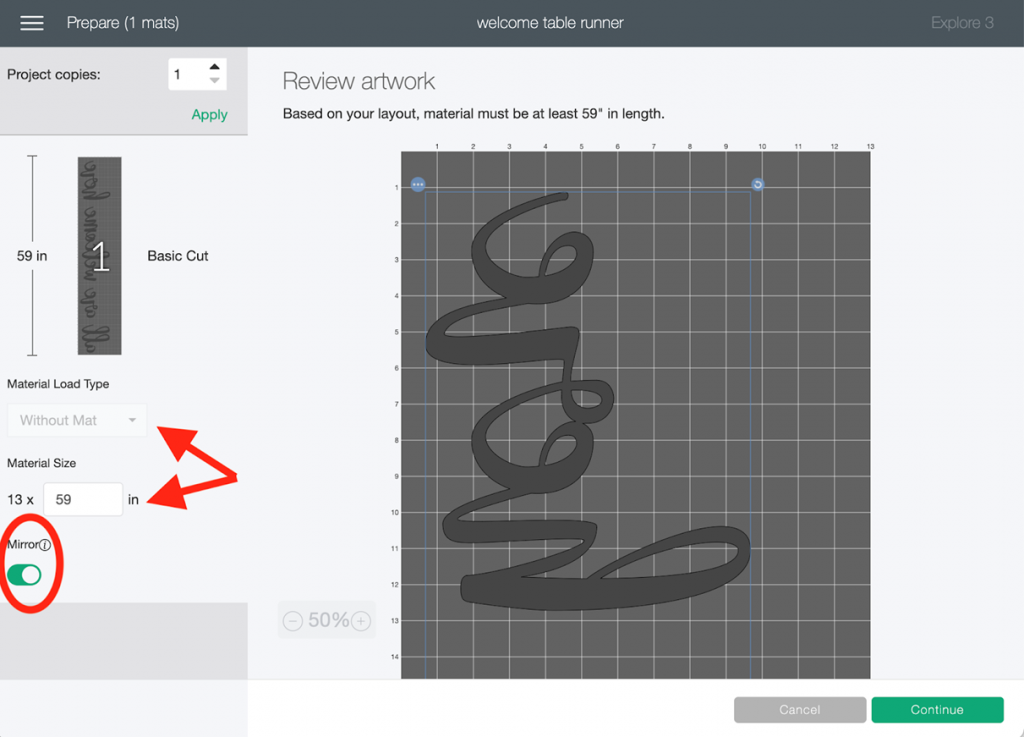
5. Now, the next step is to click “make it”, and on the next screen, you will see some cool new changes. You will have the option to select with or without a mat, depending on the material you are using (rolls of Smart Materials don’t need a mat), and the screen will actually show you how much material you need for the project.
Reminder: if you are using iron-on, don’t forget to mirror your material!
6. Click “continue” and select your materials, then load your materials, and you are ready to go! Speaking of loading materials…

Cricut just released a Roll Holder for Smart Materials, and it is the greatest thing EVER! Do you have to have it to use an Explore/Maker 3 machine or the large rolls of material? Nope! But it is so so so helpful to keep the rolls organized and lined up properly in the machine.

It simply clicks into place! Then you insert the roll into the holder and feed it through, then feed the edge of the material into the machine. Voila!

When you are making big/long projects, don’t be alarmed if the roll “balloons out” as it is cutting. That means the roll holder is doing its job!

Once your images are done cutting, there is a built-in trimmer that slides across and cuts your material for you!

7. Did you know Smart Materials can be used on a mat? Smart materials must be 13” across and at least 6” long to cut without a mat, but you don’t want to waste any unused materials from your large projects! After my images were cut, before I started weeding my project, I cut away the excess 4” of material and saved it to cut on a mat for other small projects.


8. Weed your project.


9. Find the center (of both your project and your table runner) and lay the iron-on on top of the runner.

10. Start in the center and use your EasyPress to heat sections of the table runner in increments. Head to the Cricut Heat Guide for specific times/temperatures based on your materials. You will also find instructions for removing the clear carrier sheet (warm or cool peel) in the Heat Guide.


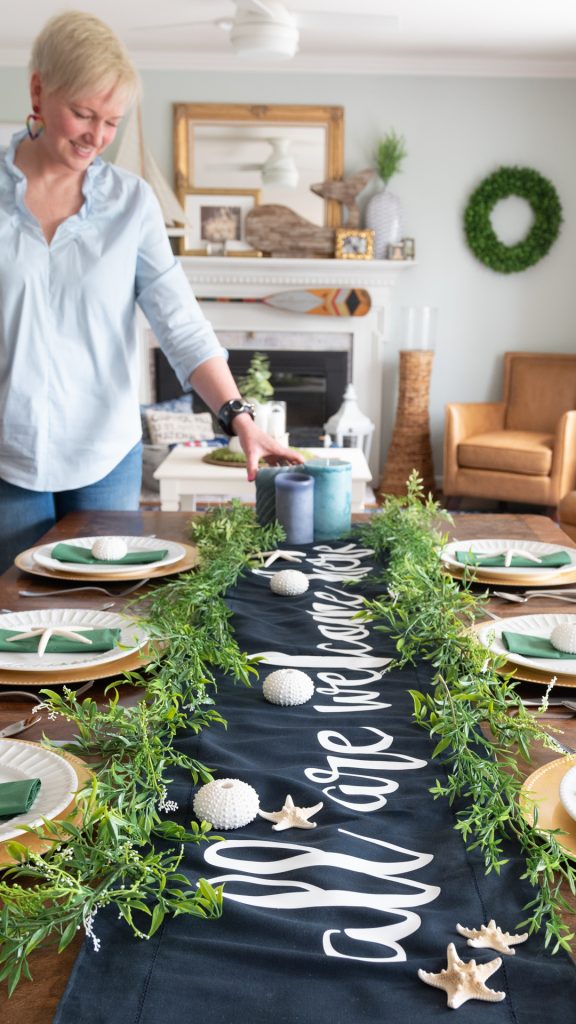
And voila! A custom table runner in one pass with the New Cricut Explore 3 (or Maker 3) and Smart Materials! So easy!
With this easy tutorial, imagine all the different ideas you can come up with! My head is already thinking about the holidays, family gatherings, and more! Plus, the fun part is that with Cricut Smart Materials, the sky is the limit when it comes to designs and length!

Now, as you can tell by the photos, I created a coastal theme for my table setting using ”fresh garlands” (aka fake garlands – LOL) and some seashells. However, you could create a table setting that includes fresh flowers. candles, or even cute home decor pieces. Just have fun making your table runner and your table your very own!
Also, if table runners are not for you, you could use this same idea to create a custom tablecloth.

If you are ready to find the perfect project, search Cricut Design Space to see tons of fun projects ranging from wall decals to outdoor projects that can be made with the new Smart Vinyl!
WHAT COLORS/SIZES/TYPES OF SMART MATERIALS ARE AVAILABLE?
If you love learning about the new machines that Cricut is making, then check out my unboxing video of the Cricut Explore 3!
In the unboxing video, I cover the entire list of supplies that will be available and talk about the machine more in-depth! You can watch the video below or on my YouTube Channel here!
HOW DOES THE MACHINE READ THE SMART MATERIALS?
I actually found this out by accident when I happened to catch them in the light! On the back of the 13” Smart Materials rolls, there are tiny, almost invisible dots on both sides. The sensors on the machines “read” the dots!


No Sew Table Runner DIY Using Cricut Smart Materials
Materials
- Cricut Explore 3
- Cricut Roll Holder for Smart Materials (optional)
- Cricut Smart Iron-on in White (comes in assorted lengths – I used 9’)
- HeatPress (I used the 12”x10” – you can use any size, or you could use an iron)
- HeatPress Mat (I used the 20”x16”)
- Table runner
- Weeding tool
Instructions
- The first step is to measure the width and length of your table runner and determine how much of a border you want around your phrase, double that number, then subtract. For example – if your table runner is 80”x 20” and you want a 3” border around your phrase, you would subtract 6” (3” x 2) from your table runner for a 74”x14” phrase measurement. My runner had some stitching around the edges, so I used that as my border and measured inside the stitching.
- Type your phrase in Design Space. I used the Annie Leu font from Cricut Access but you can also use any font on your computer.
- Resize your image to the length of your table runner measurement. Now look at the height of the phrase. If it fits into your runner measurement – great! If not, you have several choices: just change the height of the phrase by clicking the lock image (which will unlock the sizing), shrink the entire phrase (which will leave larger borders on the ends of the runner), or change fonts to find one that “fills the space” more to your liking.
- Once you are satisfied with the size of your phrase, select “weld” at the bottom right if you are using scripted letters. This will make the words cut as one image instead of individual letters. Don’t forget to check and make sure Design Space shows that you are using an Explore (or Maker) 3!
- Now, the next step is to click “make it”, and on the next screen, you will see some cool new changes. You will have the option to select with or without a mat, depending on the material you are using (rolls of Smart Materials don’t need a mat), and the screen will actually show you how much material you need for the project.Reminder: if you are using iron-on, don’t forget to mirror your material!
- Click “continue” and select your materials, then load your materials, and you are ready to go! Speaking of loading materials…Cricut just released a Roll Holder for Smart Materials, and it is the greatest thing EVER! Do you have to have it to use an Explore/Maker 3 machine or the large rolls of material? Nope! But it is so so so helpful to keep the rolls organized and lined up properly in the machine.It simply clicks into place! Then you insert the roll into the holder and feed it through, then feed the edge of the material into the machine. Voila!When you are making big/long projects, don’t be alarmed if the roll “balloons out” as it is cutting. That means the roll holder is doing its job!Once your images are done cutting, there is a built-in trimmer that slides across and cuts your material for you!
- Did you know Smart Materials can be used on a mat? Smart materials must be 13” across and at least 6” long to cut without a mat, but you don’t want to waste any unused materials from your large projects! After my images were cut, before I started weeding my project I cut away the excess 4” of material and saved it to cut on a mat for other small projects.
- Did you know Smart Materials can be used on a mat? Smart materials must be 13” across and at least 6” long to cut without a mat, but you don’t want to waste any unused materials from your large projects! After my images were cut, before I started weeding my project, I cut away the excess 4” of material and saved it to cut on a mat for other small projects.
- Weed your project.
- Find the center (of both your project and your table runner) and lay the iron-on on top of the runner.
- Start in the center and use your EasyPress to heat sections of the table runner in increments. Head to the Cricut Heat Guide for specific times/temperatures based on your materials. You will also find instructions for removing the clear carrier sheet (warm or cool peel) in the Heat Guide.
LOOKING FOR OTHER CRICUT HOME DECOR PROJECTS? CHECK OUT THESE BLOG POSTS:














Follow for more!
Make sure to follow us on Facebook, Pinterest, Instagram, Twitter and Tiktok for all the latest craft projects! Plus you can shop all our favorites over at Kingston Crafts!